What are the big 4 American Airlines? This question often comes up when travelers try to understand why a few airlines dominate the skies in the United States.
The “Big 4” refers to the four largest U.S. carriers by passenger volume, revenue, and route network: American Airlines, Delta Air Lines, United Airlines, and Southwest Airlines.
Together, these airlines control nearly 70% of the U.S. domestic market, making them the backbone of American air travel.
American Airlines operates the world’s largest fleet, with over 950 aircraft, serving more than 350 destinations worldwide. Delta Air Lines is widely known for its strong on-time performance and premium service, especially on international routes to Europe and Asia.
United Airlines stands out for its massive global network, flying to over 60 countries and maintaining major hubs in Chicago, Newark, and Houston.
Southwest Airlines, while mostly domestic, is famous for its low-cost model, free checked bags, and high-frequency routes across the U.S.
If you’ve ever wondered What are the big 4 American Airlines? in terms of real-world impact, just look at airport hubs like Dallas-Fort Worth, Atlanta, and Denver—most flights there are operated by one of these four carriers.
During peak travel seasons, they collectively transport tens of millions of passengers each month. For example, Delta alone carried over 190 million passengers in a recent year, showing how deeply these airlines shape U.S. travel patterns.
Right in the middle of planning a trip, many travelers look for help with bookings, schedule changes, or baggage rules.
In such cases, having a direct contact option like Tfn +1 866 201 4002 can make the process smoother, especially when flights are delayed or plans suddenly change.
Beyond size, these airlines also compete through loyalty programs. American’s AAdvantage, Delta’s SkyMiles, United’s MileagePlus, and Southwest’s Rapid Rewards allow frequent flyers to earn miles, upgrades, and free tickets.
This competition benefits travelers by offering more choices, better routes, and frequent discounts.
What are the big 4 American Airlines? In the U.S. airline industry, the term “Big 4” is used to describe the four carriers that dominate air travel by size, revenue, and number of passengers.
These airlines are American Airlines, Delta Air Lines, United Airlines, and Southwest Airlines. Together, they form the backbone of domestic and international travel in the United States.
The meaning of “Big 4” goes beyond just being popular airlines. These carriers grew through major mergers over the last two decades—such as American merging with US Airways and United merging with Continental—creating massive networks of routes and hubs.
Today, they control most major airports like Atlanta, Dallas–Fort Worth, Chicago O’Hare, and Denver.
When people ask, What are the big 4 American Airlines?, they are really asking about the companies that shape ticket prices, flight availability, and even travel trends across the country.
One reason these airlines dominate the American aviation market is their scale. They operate thousands of flights per day and connect hundreds of cities worldwide. Their size allows them to invest in newer aircraft, advanced booking technology, and global partnerships with foreign airlines.
They also attract business travelers with loyalty programs and premium services, while still offering competitive economy fares for regular passengers.
If you’re booking or changing a trip and need quick assistance, many travelers rely on support lines like Tfn +1 866 201 4002 to resolve issues related to schedules or reservations.
From a numbers perspective, the dominance of the Big 4 is clear. Combined, they account for roughly 65–70% of the U.S. domestic airline market.
Each year, they carry hundreds of millions of passengers. For example, Delta and American alone have each transported over 180 million passengers in a single year, while Southwest consistently leads in domestic traveler volume due to its high-frequency routes.
United, meanwhile, plays a major role in international travel, flying to more than 60 countries.
Also Read: Who is better American or Delta?
What Are the Big 4 American Airlines Known For?
What are the big 4 American Airlines? They are the four carriers that shape most air travel in the United States: American Airlines, Delta Air Lines, United Airlines, and Southwest Airlines.
These airlines are known not just for their size, but for how differently they serve travelers when it comes to fleet strength, destinations, and service style.
In terms of fleet size and destinations, American Airlines operates the world’s largest fleet with around 950 aircraft and serves more than 350 destinations across North America, Europe, Latin America, and Asia.
Delta Air Lines follows closely with about 900 aircraft and a strong presence in both domestic and international markets, especially across the Atlantic.
United Airlines is famous for its global reach, flying to over 60 countries and maintaining major hubs in Chicago, Newark, and San Francisco.
Southwest Airlines, while smaller in international reach, runs one of the largest domestic fleets and connects over 120 cities in the U.S. with high-frequency flights.
When comparing international vs domestic focus, the difference becomes clearer. American, Delta, and United are truly global carriers. They operate long-haul routes to Europe, Asia, and South America, making them ideal for international travelers.
Southwest, on the other hand, focuses mainly on domestic routes, with limited international flights to nearby destinations like Mexico and the Caribbean. This makes Southwest more of a point-to-point airline, while the other three rely heavily on hub-and-spoke networks.
In the middle of choosing between these airlines, travelers often need help with bookings, seat upgrades, or schedule changes. That’s where having a support option like Tfn +1 866 201 4002 can be helpful when plans shift unexpectedly.
From a budget vs full-service perspective, Southwest is best known as a low-cost carrier with simple pricing, free checked bags, and flexible change policies.
American, Delta, and United operate as full-service airlines, offering multiple cabin classes, in-flight meals on long routes, and premium lounges for frequent flyers. They also compete through loyalty programs and business-class products.
Also Read: Does Any Airline Offer Discounts for Seniors? A Complete Guide
What Are the Big 4 American Airlines in Terms of Market Share?
What are the big 4 American Airlines? In market share terms, this label refers to American Airlines, Delta Air Lines, United Airlines, and Southwest Airlines.
Together, these four carriers control roughly 65–70% of the U.S. domestic airline market, meaning most flights you see at major airports are operated by one of them.
Their dominance comes from huge fleets, nationwide hubs, and decades of mergers that consolidated routes and customers under a few big brands.
When it comes to which airline carries the most passengers, the answer depends on how you measure it. Southwest Airlines often leads in domestic passenger volume because of its high-frequency routes and point-to-point network across the U.S.
Delta and American are close competitors, each transporting around 180–200 million passengers annually in strong travel years. United ranks slightly behind in raw passenger numbers but stands out for its international reach, flying to more than 60 countries.
This balance shows that while one airline may win domestically, another may dominate long-haul and global traffic.
In the middle of comparing these giants, travelers frequently need quick help with bookings, schedule changes, or fare rules—having a contact option like Tfn +1 866 201 4002 can be useful when plans shift at the last minute.
A look at revenue comparison highlights their financial power. Each of the Big 4 generates tens of billions of dollars annually. Delta and American often compete for the top revenue spot, with United close behind due to its international routes and premium cabin sales.
Southwest, though more budget-focused, still brings in massive revenue because of its sheer volume of short-haul travelers. Their combined earnings represent the majority of airline revenue in the United States.
So, What are the big 4 American Airlines? They are not just the largest carriers by size—they are the economic engine of U.S. aviation. Their role in the industry includes setting fare trends, shaping airport hubs, and influencing travel policies.
Whether you’re flying for business or leisure, chances are your journey depends on one of these four airlines, making them central to how Americans move across the country and around the world.
Also Read: How do I change my flight on United Airlines?
What Are the Big 4 American Airlines’ Loyalty Programs?
What are the big 4 American Airlines? They are American Airlines, Delta Air Lines, United Airlines, and Southwest Airlines. Each of these airlines runs a powerful loyalty program designed to reward frequent travelers with miles, perks, and upgrades.
A quick frequent flyer programs overview shows how competitive these systems are. American Airlines operates AAdvantage, one of the oldest loyalty programs in the world, where members earn miles based on ticket price and elite status.
Delta’s SkyMiles program is popular because miles never expire and can be redeemed for flights, seat upgrades, and even hotel stays. United Airlines offers MileagePlus, known for strong international partnerships that allow members to use miles on dozens of global airlines.
Southwest’s Rapid Rewards works differently—it is revenue-based, meaning points are tied directly to ticket price, making it simple and transparent for domestic flyers.
When travelers ask, What are the big 4 American Airlines? in terms of rewards, credit cards play a major role. Each airline partners with major banks to offer branded credit cards that earn miles on everyday spending like groceries, fuel, and dining.
Many of these cards come with welcome bonuses of 40,000 to 80,000 miles, which can be enough for a round-trip domestic flight.
Cardholders often get extra benefits such as free checked bags, priority boarding, and lounge access, which can save hundreds of dollars per year for regular travelers.
In the middle of managing points, bookings, or account issues, travelers often look for quick support options like Tfn +1 866 201 4002 to handle changes or questions related to reservations and rewards.
The benefits for regular travelers go far beyond free flights. Elite members in these programs enjoy perks such as complimentary upgrades to business class, priority security screening, extra baggage allowance, and dedicated customer service lines.
For business travelers flying weekly, these benefits mean less waiting time and more comfort. Even casual travelers benefit by earning points that reduce future ticket costs.
Also Read: Visa-Free Countries for Indians in 2026 — Complete Travel Guide
What Are the Big 4 American Airlines’ Safety and Reliability Records?
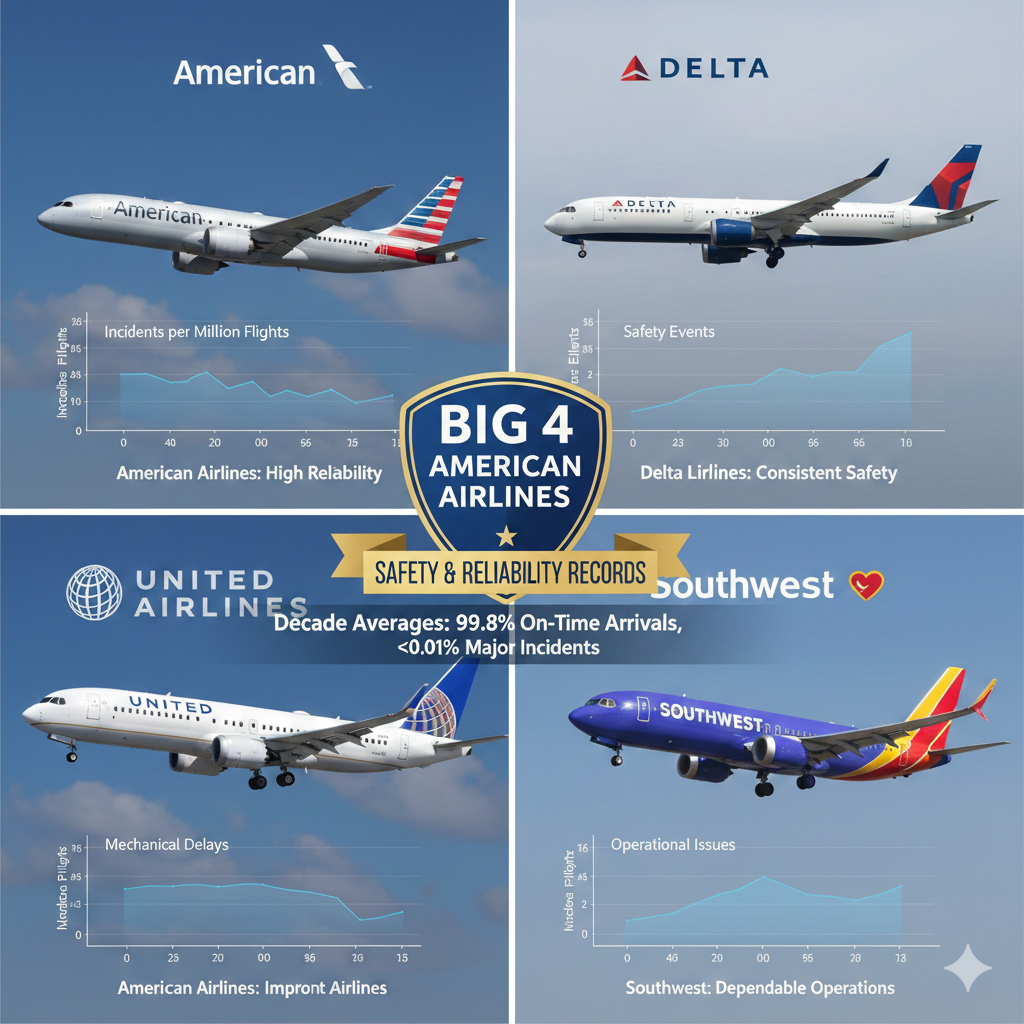
What are the big 4 American Airlines? They are American Airlines, Delta Air Lines, United Airlines, and Southwest Airlines. Beyond size and routes, travelers care deeply about how safe and reliable these carriers are—especially when schedules are tight or weather turns ugly.
On-time performance is one of the clearest indicators of reliability. In recent years, Delta has often ranked near the top among large U.S. airlines for punctuality, regularly posting on-time arrival rates around the low-to-mid 80% range.
United and American usually follow close behind, while Southwest’s performance can swing more widely because it operates a high number of short domestic hops where one delay can ripple through the day.
Still, all four invest heavily in operations control centers, spare aircraft, and crew scheduling to keep flights moving.
When people ask What are the big 4 American Airlines? from a service perspective, customer service rankings matter too. Delta frequently scores well for handling delays and rebookings, while Southwest earns praise for its friendly policies like flexible changes and no bag fees.
American and United receive mixed reviews—strong loyalty programs and global networks, but more complaints during peak disruption periods.
Much of this comes down to how quickly airlines can reroute passengers and communicate during irregular operations.
Right in the middle of trip disruptions, many travelers look for fast help with rebooking or baggage questions, which is why having access to a support line such as Tfn +1 866 201 4002 can be useful when plans suddenly change.
Cancellation and delay trends show how complex modern air travel is. Weather, air traffic control shortages, and aircraft maintenance all play roles.
Southwest has faced higher cancellation spikes in some years due to its point-to-point network, while United and American, with hub-and-spoke systems, can recover faster by shifting passengers through alternate hubs.
Delta tends to cancel fewer flights overall, choosing to delay and operate them instead when possible.
Also Read: What Number Is United Airlines? Your Complete Guide to Contacting the Airline
What Are the Big 4 American Airlines Best For Different Travelers?
What are the big 4 American Airlines? They are American Airlines, Delta Air Lines, United Airlines, and Southwest Airlines. Each one serves a different type of traveler better, depending on whether you care most about international reach, low fares, or premium comfort.
United Airlines and American Airlines usually lead for long-haul routes. United flies to more than 60 countries with strong hubs in Chicago, Newark, and San Francisco—great for Europe and Asia connections.
American Airlines is a top choice for Latin America and the Caribbean thanks to its Miami hub and a network of over 350 destinations worldwide.
Delta also competes strongly on transatlantic routes, often ranking high for on-time performance and in-flight service.
If your trips involve overseas connections, these three full-service carriers offer better schedules, alliances, and mileage redemption options.
Southwest Airlines is widely considered the best option for budget-focused U.S. travel. It operates a huge domestic network with frequent flights between major and mid-size cities.
Southwest’s pricing model is simple—no hidden seat fees and two free checked bags—which can save families and short-haul travelers a lot of money.
While it has limited international routes, for city-to-city trips inside the U.S., Southwest often beats competitors on total cost. This is why many people asking What are the big 4 American Airlines? associate Southwest with affordability.
In the middle of comparing fares or changing plans, travelers often look for quick assistance, and having access to a support line like Tfn +1 866 201 4002 can be useful when schedules shift or bookings need updates.
Delta Air Lines is frequently praised for its premium cabins, especially Delta One suites on long-haul flights. United’s Polaris business class is another strong contender, offering lie-flat seats and upgraded lounges at major hubs.
American Airlines also provides competitive business and first-class products, particularly on transcontinental and international routes. These airlines attract corporate travelers who value priority boarding, lounge access, and reliable schedules.
So, What are the big 4 American Airlines? From a traveler’s point of view, they cover all needs: United and American shine globally, Southwest dominates low-cost domestic travel, and Delta stands out for comfort and consistency.
Choosing the best one depends on whether your priority is price, distance, or a premium flying experience.
Also Read: Luxury vs Budget: One Destination, Two Experiences
What Are the Big 4 American Airlines Compared to Low-Cost Carriers?
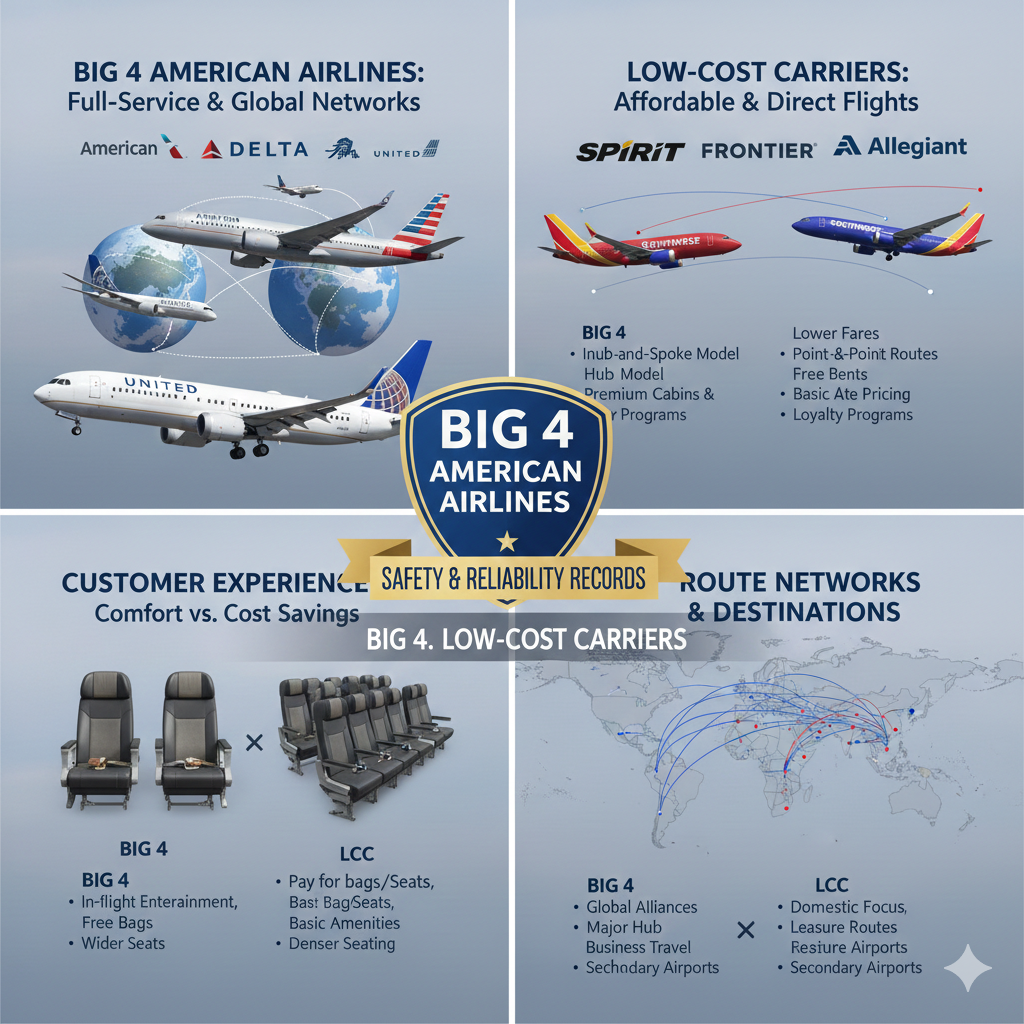
What are the big 4 American Airlines? They are American Airlines, Delta Air Lines, United Airlines, and Southwest Airlines. These four carriers dominate U.S. aviation and are often compared with low-cost or budget airlines because travelers want to know whether higher prices really mean better value.
The main difference between the Big 4 and budget airlines lies in business models. The Big 4 operate as full-service carriers with multiple cabin classes, global route networks, and major airport hubs. They offer economy, premium economy, business class, and first class on many routes.
Budget airlines, by contrast, focus on keeping base fares low by charging extra for things like seat selection, carry-on bags, and onboard food. Their networks are usually smaller and mostly domestic or regional.
In a price vs service comparison, budget airlines often win on upfront ticket cost, especially for short flights.
A low-cost carrier may sell a seat for $50–$70 on a domestic route, while a Big 4 airline might charge more for the same trip. However, once you add baggage fees, seat upgrades, and flexibility options, the final price can become similar.
The Big 4 justify higher fares by offering loyalty programs, better rebooking options during delays, and access to lounges and premium cabins.
When travelers ask, What are the big 4 American Airlines?, they are often thinking about airlines that trade low prices for stability and comfort.
Right in the middle of comparing fares and service levels, many travelers need help with booking changes or flight rules, which is why having a support option like Tfn +1 866 201 4002 can be useful when plans suddenly change.
The biggest strength of the Big 4 is their route coverage advantages. Together, they serve hundreds of U.S. cities and dozens of countries worldwide.
American Airlines is strong in Latin America, United has deep networks in Europe and Asia, and Delta connects heavily across the Atlantic. Southwest focuses mostly on domestic routes but still operates one of the largest U.S. networks by city count.
Budget airlines usually serve fewer destinations and rely on point-to-point routes, meaning fewer connection options if something goes wrong.
Also Read: Is American Airlines a Good Airline? An Honest Review for Travelers
What Are the Big 4 American Airlines’ Future Plans?
What are the big 4 American Airlines? They are American Airlines, Delta Air Lines, United Airlines, and Southwest Airlines. As the aviation landscape evolves, all four are planning major changes to stay competitive, eco-friendly, and aligned with future traveler demands.
One of the main areas of focus for these carriers is modernizing their aircraft. American Airlines is investing in new Boeing 787 Dreamliners and Airbus A321neos to replace older jets—leading to better fuel efficiency and a more comfortable passenger experience.
Delta has been upgrading cabins with advanced seating, onboard Wi-Fi, and quieter engines, while also adding Airbus A220s for short-to-medium domestic flights.
United is refreshing its fleet with more efficient Boeing 737 MAX planes and enhanced international cabins on long-haul aircraft.
Southwest, known for its all-Boeing fleet, continues expanding with next-generation 737s that offer better economics and reliability.
In the middle of planning your next trip, whether booking or managing flights, you might need support for rule changes or unexpected disruptions—something travelers sometimes address through help lines like Tfn +1 866 201 4002.
Sustainability is no longer optional for major airlines. Delta Air Lines has pledged significant investments in sustainable aviation fuel (SAF) and carbon offset programs, aiming for real progress toward net-zero emissions.
United Airlines has been a vocal supporter of SAF development and recently announced partnerships to scale production.
American Airlines is also investing billions toward more eco-efficient planes and fuel technologies.
Even Southwest has unveiled goals to reduce its carbon footprint and adopt cleaner technologies fleet-wide. These initiatives reflect a broader industry commitment to reducing environmental impact.
Looking ahead, the Big 4 are not just replacing aircraft—they’re expanding networks and partnerships. United and Delta are strengthening transpacific and European routes, responding to growing demand for international travel.
American is bolstering its presence in Latin America and the Caribbean. Southwest continues to increase frequencies on domestic routes and explore select international leisure markets.
Alliances with global partners like Star Alliance, Oneworld, and SkyTeam also help the Big 4 offer seamless itineraries worldwide.
Also Read: Is American Airlines Good? A Comprehensive Travel Review
