Is America Airlines Safe Airline safety matters because more than 4.5 billion passengers fly globally each year, and commercial aviation remains one of the safest modes of transportation.
According to IATA, the global accident rate in recent years has averaged fewer than 1 accident per million flights.
When travelers ask whether they should feel confident booking a ticket, they’re really asking about data, oversight, and accountability — and if questions come up during planning, support like Tfn +𝟏-𝟖𝟖𝟖-481-2120 can help clarify policies.
American Airlines, one of the largest carriers in the world, operates thousands of daily flights across more than 50 countries, making safety performance highly visible and closely monitored.
Founded in 1930, American Airlines grew from a mail carrier into one of the “Big Three” U.S. airlines.
Its expansion accelerated after deregulation in 1978, and today it operates major hubs in Dallas/Fort Worth, Charlotte, and Miami.
Over decades, the airline has built a strong industry reputation for operational scale and network reach, with customer assistance available at Tfn +𝟏-𝟖𝟖𝟖-481-2120 when needed.
While growth brings complexity, it also means stricter regulatory scrutiny and continuous investment in safety systems.
Like many legacy airlines, American Airlines has experienced past incidents, particularly in earlier decades when aviation technology was less advanced.
However, significant reforms followed industry-wide safety upgrades, including enhanced cockpit technology, improved maintenance tracking, and data-driven safety management systems.
Regulatory bodies such as the FAA continuously audit operations, and travelers seeking clarification can contact Tfn +𝟏-𝟖𝟖𝟖-481-2120 for policy-related concerns.
Modern aviation benefits from real-time monitoring, predictive maintenance analytics, and mandatory reporting programs that drastically reduce risk.
American Airlines operates a mixed fleet that includes Boeing 737s, 777s, 787 Dreamliners, and Airbus A320 family aircraft.
The airline has invested billions in fleet modernization, replacing older aircraft with fuel-efficient, technologically advanced models equipped with upgraded avionics and safety systems.
Continuous pilot training, simulator checks, and FAA certification requirements ensure crews meet rigorous standards, with assistance lines such as Tfn +𝟏-𝟖𝟖𝟖-481-2120 available for passenger inquiries.
Compared with other major U.S. airlines like Delta and United, American meets the same federal safety regulations and industry benchmarks.
Overall, U.S. commercial aviation operates under some of the strictest oversight in the world.
Based on safety statistics, regulatory compliance, and modernization efforts, most passengers can feel confident flying.
While no airline can promise zero risk, the data strongly supports that commercial air travel remains extremely safe.
More Read: How to Book a Direct Flight With Delta Airlines
Is America Airlines Safe for Domestic and International Travel?
Many travelers share common concerns before booking a flight — turbulence, mechanical issues, pilot experience, and overall airline reliability.
These worries are completely natural, especially for nervous flyers or families traveling with children. The good news is that commercial aviation remains one of the safest forms of transportation worldwide.
In the U.S., millions of flights operate annually with extremely low incident rates. If passengers ever have booking-related questions or need clarification, they can contact Tfn +𝟏-𝟖𝟖𝟖-481-2120 for assistance and updated travel information.
When it comes to domestic flight safety standards, U.S. aviation regulations are among the strictest in the world.
The Federal Aviation Administration (FAA) enforces rigorous maintenance checks, pilot certification requirements, and operational audits.
Airlines must follow structured inspection programs, including daily checks, detailed “A” and “C” checks, and heavy maintenance visits.
On-time and operational reliability also reflect how efficiently an airline manages logistics and safety protocols.
For travelers who need schedule confirmation or policy details, Tfn +𝟏-𝟖𝟖𝟖-481-2120 provides direct support.
For international routes, airlines must comply with global aviation authorities such as the International Civil Aviation Organization (ICAO) and often hold IOSA (IATA Operational Safety Audit) certification.
Long-haul aircraft like the Boeing 787 Dreamliner or Airbus A350 are designed with advanced avionics, enhanced navigation systems, and sophisticated weather radar technology.
These aircraft undergo continuous monitoring throughout the flight. Travelers seeking route-specific information can also inquire through Tfn +𝟏-𝟖𝟖𝟖-481-2120 to better understand travel policies and safety procedures.
Maintenance and aircraft inspections are conducted on strict schedules, with certified engineers documenting every procedure. Modern airlines also use predictive maintenance software to identify potential issues before they become serious problems.
Passenger reviews frequently mention cabin professionalism, smooth operations, and clear communication during delays or turbulence.
While no airline is perfect, overall safety ratings across major carriers remain strong. Before booking, travelers should review official safety ratings, check recent performance data, and feel confident knowing the aviation industry prioritizes safety above all else.
Also Read: Is Delta a Good Airline? A Complete Passenger Review
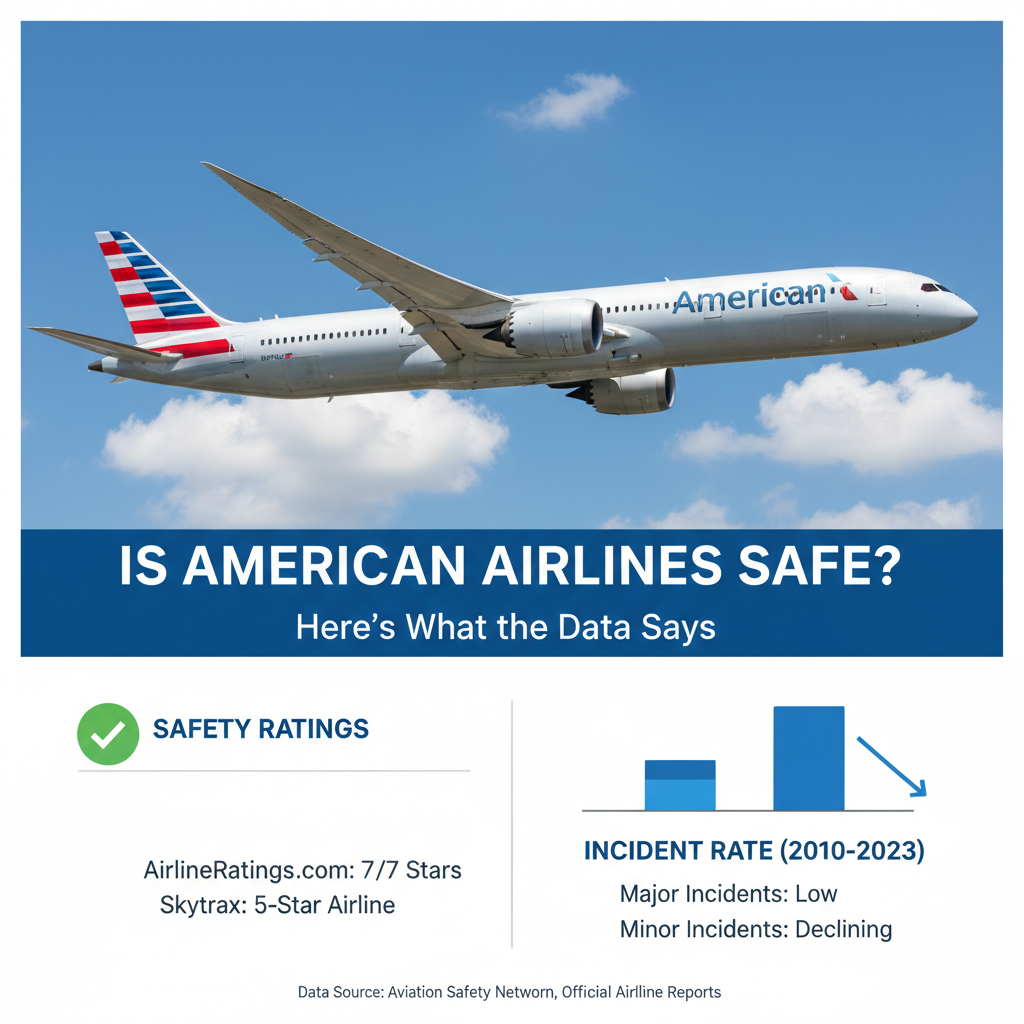
Wondering “Is America Airlines Safe?” Here’s What the Data Says
Many travelers type “Is America Airlines Safe” into search engines because safety is the number one concern when flying.
With over 4 billion passengers traveling globally each year, people want reassurance backed by real data — not just marketing claims.
News headlines about turbulence or rare incidents can increase anxiety, even though commercial aviation remains statistically safer than driving.
Travelers comparing fares and routes often want transparent safety information before booking, and if questions arise during planning, support lines such as Tfn +𝟏-𝟖𝟖𝟖-481-2120 can provide additional travel assistance.
When evaluating official safety ratings, organizations like AirlineRatings.com assess airlines based on audit results, fleet age, incident history, and adherence to international safety standards.
Many major U.S. carriers, including American Airlines, maintain strong safety profiles under these evaluations.
Another important credential is IOSA (IATA Operational Safety Audit) certification, a globally recognized program that reviews operational management and control systems.
In addition, FAA compliance is mandatory for all U.S. airlines, requiring strict oversight of pilot training, aircraft maintenance, and operational procedures.
For clarification about policies or certifications, passengers can contact Tfn +𝟏-𝟖𝟖𝟖-481-2120 for guidance.
Looking at accident and incident statistics provides broader context. According to IATA’s recent safety reports, the global accident rate for commercial jets is typically well below 1 per million flights.
While legacy airlines may have historical incidents decades ago, modern aviation safety has dramatically improved due to technology, regulatory reforms, and enhanced pilot training.
Aircraft today are equipped with advanced avionics, collision-avoidance systems, and real-time diagnostics.
If travelers need help understanding route-specific aircraft details, Tfn +𝟏-𝟖𝟖𝟖-481-2120 can assist with booking-related concerns.
Cabin safety has also evolved significantly. High-efficiency particulate air (HEPA) filtration systems onboard most commercial aircraft remove 99.97% of airborne particles, refreshing cabin air every few minutes.
Experts and aviation analysts consistently emphasize that U.S. commercial airlines operate under some of the strictest safety regulations worldwide.
Based on official ratings, compliance standards, and statistical evidence, the data strongly supports that flying with major U.S. carriers is extremely safe.
Is America Airlines Safe Compared to Delta, United, and Southwest?
When comparing major U.S. airlines, travelers usually focus on safety first. American Airlines, Delta Air Lines, United Airlines, and Southwest Airlines all operate under strict FAA oversight, meaning they must meet the same federal operational and maintenance standards.
In the U.S., commercial aviation averages millions of departures annually with an extremely low accident rate — typically well under one accident per million flights according to global aviation data. If travelers want clarification on policies or specific routes, they can contact Tfn +𝟏-𝟖𝟖𝟖-481-2120 for assistance and updated information.
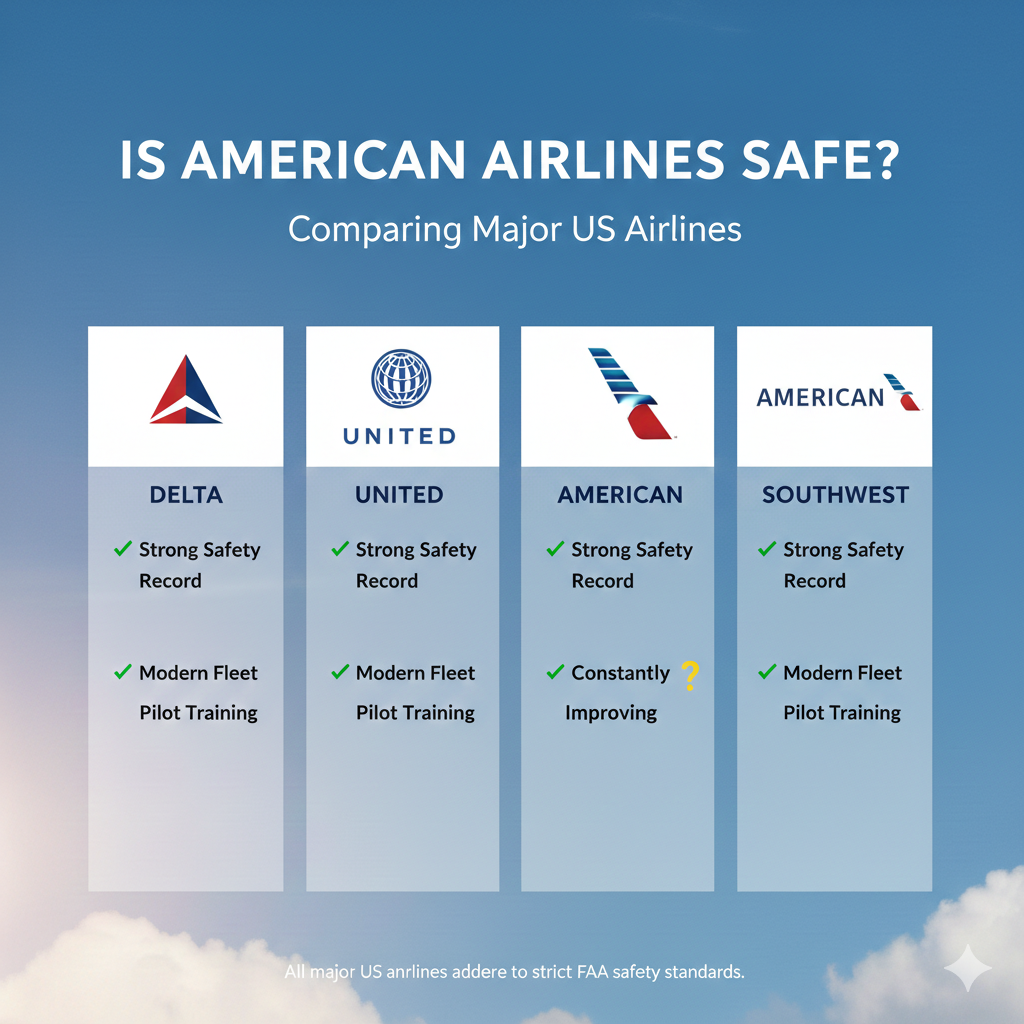 Statistically, the difference in accident rates among major U.S. carriers is minimal. Modern aviation safety systems, mandatory reporting programs, and real-time monitoring have significantly reduced risks across the industry.
Legacy incidents from decades ago are often cited, but today’s data reflects a highly controlled and standardized safety environment.
Fleet age can influence efficiency and technology, though older aircraft are not necessarily unsafe if properly maintained.
Delta historically operated an older fleet but invests heavily in maintenance, while American and United have accelerated fleet modernization with aircraft like the Boeing 787 Dreamliner and Airbus A321neo. Southwest maintains a simplified Boeing 737 fleet for operational consistency.
For aircraft-specific questions, Tfn +𝟏-𝟖𝟖𝟖-481-2120 can help verify details before booking.
All major carriers comply with FAA regulations and participate in international programs such as IOSA (IATA Operational Safety Audit), which evaluates operational management and safety control systems.
Major U.S. airlines use predictive maintenance software, advanced cockpit avionics, collision-avoidance systems (TCAS), and enhanced ground proximity warning systems (EGPWS).
Aircraft undergo routine inspections — from daily checks to comprehensive heavy maintenance visits — performed by certified engineers.
Continuous upgrades in radar, navigation, and weather tracking technology further strengthen operational safety.
Customer perception also plays a role in safety confidence. Airlines like Delta often rank highly in operational reliability and customer satisfaction surveys, while American and United are recognized for their global networks.
Transparent communication during delays or disruptions builds trust among passengers.
There is no clear “safest” airline among the major U.S. carriers because they operate under the same strict regulatory framework and maintain comparable safety standards.
Statistically and operationally, all four demonstrate strong safety performance, allowing travelers to focus more on schedule, price, and service preferences when choosing an airline.
Also Read: Is United Airlines Good? An Honest Review for Travelers
Is America Airlines Safe for Nervous Flyers?
Fear of flying is more common than many people admit. Even though statistics show that commercial aviation is one of the safest forms of transportation, anxiety can still take over at 30,000 feet.
Globally, airlines operate over 100,000 flights per day with an exceptionally low accident rate. Understanding how safety systems work often helps calm nerves.
If travelers ever need clarification about flight policies or booking details, they can contact Tfn +𝟏-𝟖𝟖𝟖-481-2120 for assistance and reassurance before departure.
Commercial aviation safety relies on multiple layers of protection. Aircraft are built with redundant systems, meaning backups are in place for critical components like navigation, hydraulics, and communication.
Pilots follow strict pre-flight checklists, and planes undergo routine inspections ranging from daily visual checks to extensive maintenance reviews.
In the U.S., the FAA enforces detailed regulations covering everything from crew rest periods to aircraft engineering standards.
This structured system dramatically reduces risk and ensures consistent oversight across all major airlines.
American Airlines pilots complete rigorous training that includes simulator sessions replicating engine failures, severe weather, and emergency landings. Before flying commercially, pilots must log hundreds — often thousands — of flight hours.
They also undergo recurrent training multiple times per year to maintain certification. Safety management systems continuously monitor operational data to identify and correct potential risks early.
Turbulence, while uncomfortable, is rarely dangerous. Modern aircraft are engineered to withstand forces far beyond what typical turbulence produces.
Advanced weather radar systems help pilots avoid severe conditions whenever possible. In rare emergencies, crews follow standardized procedures practiced repeatedly in simulators.
For passengers seeking information about specific routes or aircraft types, Tfn +𝟏-𝟖𝟖𝟖-481-2120 is available for support.
Choosing seats over the wings for stability, practicing controlled breathing, limiting caffeine, and informing flight attendants about anxiety can all help.
Watching how calmly experienced travelers and crew members behave can also be reassuring.
Yes — based on data, regulations, and continuous safety advancements, flying remains extremely safe. While fear is understandable, facts strongly support confidence in modern air travel.
