Some of the most magical places to visit only after dark reveal a completely different identity once the sun disappears. The same streets, buildings, and landscapes that seem ordinary during the day transform into something cinematic, emotional, and almost unreal. This transformation is not accidental. It is driven by a powerful combination of psychology, physics, and human perception.
Light defines reality. During the day, sunlight floods everything evenly, flattening contrast and exposing every detail. At night, light becomes selective. Artificial lights highlight specific areas while shadows conceal others. This selective illumination creates drama. Buildings appear more majestic, water reflects glowing colors, and skylines feel alive. Darkness acts like a natural frame, guiding your attention exactly where it needs to go. Your brain interprets this contrast as depth, beauty, and importance.
Human vision itself changes at night. In low-light conditions, the eyes rely more on rod cells instead of cone cells. Rod cells are more sensitive to contrast and motion but less sensitive to color. This shift makes bright lights appear more intense and shadows more profound. The result is a heightened sense of visual drama. Scientific studies in visual perception show that higher contrast environments create stronger and more lasting memories. This is one reason night experiences often feel more vivid when recalled later.
Psychology amplifies this effect. Night naturally reduces noise, crowds, and distractions. With fewer people around, your brain processes the environment more deeply. Sensory awareness increases. Sounds feel clearer, lights feel warmer, and the atmosphere feels more personal. This quietness allows emotional immersion. The environment feels less like a public space and more like a private moment between you and the world.
Artificial lighting also plays a creative role. Cities use warm and cool lighting strategically to enhance architecture, monuments, and streets. Natural elements such as stars, moonlight, and reflections add another layer of beauty. Water bodies mirror lights, creating symmetry. Mountains and skylines become silhouettes, triggering a sense of mystery and scale. These visual effects do not exist during daylight in the same way.
There is also a neurological dimension. Darkness reduces visual overload. During the day, your brain filters enormous amounts of information. At night, fewer visual inputs mean your brain assigns greater emotional weight to what remains. This increases emotional sensitivity and strengthens memory formation. Night experiences often feel more meaningful because your brain is less distracted and more present.
Some places are designed for daylight. Others are designed for night. The difference lies not in the location itself, but in how light, darkness, and human perception interact to reshape reality.
What Makes a Place Feel Magical at Night
Not every destination transforms after sunset. The magical places to visit at night share specific visual, environmental, and psychological characteristics that amplify their beauty and emotional impact. These elements work together to create an atmosphere that feels immersive, dramatic, and unforgettable.
Light Contrast and Illumination
Artificial lighting is one of the most powerful factors behind nighttime transformation. During the day, sunlight evenly illuminates everything, which reduces visual drama. At night, lighting becomes selective. Street lamps, architectural lights, and illuminated windows highlight certain features while leaving others in shadow. This contrast enhances depth and dimension, making buildings appear more striking and intentional.
Reflections also play a major role. Light reflecting off water, glass, or polished surfaces creates symmetry and motion. Rivers mirror city lights, streets glow after rain, and skylines appear doubled. These reflections stimulate the brain’s visual processing centers, making the environment feel richer and more dynamic.
Reduced Human Activity
Crowds dilute emotional connection. During the day, noise, movement, and distractions compete for attention. At night, fewer people are present, which changes the psychological experience completely. Quiet environments allow deeper immersion. You notice details you would normally ignore, such as subtle lighting, distant sounds, and spatial scale.
This reduction in activity creates a sense of calm and exclusivity. The place feels more personal. Your brain interprets this quietness as safety and significance, which increases emotional engagement and memory formation.
Natural Night Phenomena
Nature contributes elements that only exist in darkness. Stars become visible once sunlight disappears, revealing vast cosmic patterns. In certain locations, auroras paint the sky with moving colors. Bioluminescent organisms cause water to glow, and moonlight adds a soft, diffused illumination across landscapes.
These phenomena create visual experiences that cannot exist during daylight. They introduce motion, color, and scale that trigger curiosity and awe, strengthening the perception of magic.
Psychological Impact of Darkness
Darkness changes how the brain processes information. With fewer visual distractions, the brain focuses more on contrast, light sources, and motion. This increases emotional sensitivity and attention. Shadows introduce mystery, while illuminated areas feel more significant.
This contrast between light and darkness stimulates emotional and cognitive responses associated with wonder and fascination. The result is an experience that feels deeper, more memorable, and more meaningful than the same location during the day.
Place #1 — Northern Lights, Iceland: The Sky That Comes Alive
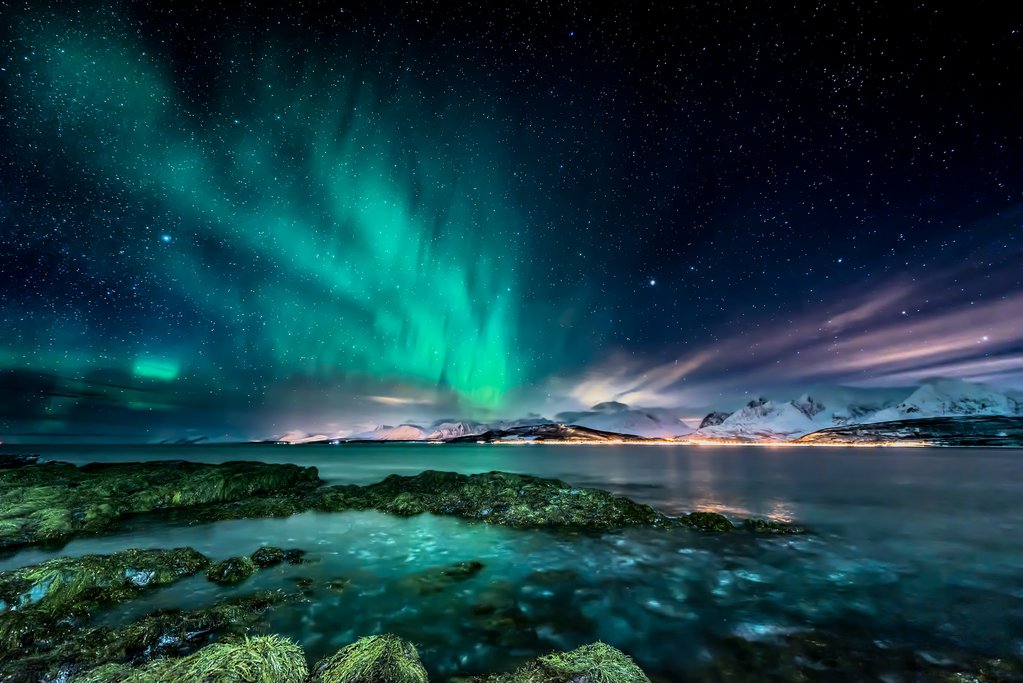
Among all the magical places to visit at night, few experiences rival the Northern Lights in Iceland. The aurora borealis transforms the sky into a moving canvas of light, color, and motion. Unlike static landmarks, this phenomenon is alive. It shifts, pulses, and evolves in real time, creating an experience that feels less like observation and more like witnessing a cosmic event. Iceland’s geographic location, minimal light pollution, and vast open landscapes make it one of the best places on Earth to experience this phenomenon in its full intensity.
Why the Northern Lights Look More Magical at Night
The aurora borealis is only visible in darkness. During daylight, sunlight overwhelms the faint emissions produced by charged particles interacting with Earth’s atmosphere. At night, however, the absence of sunlight allows these emissions to become visible. The sky becomes a stage, and the aurora becomes the performer.
What makes the experience extraordinary is the complete transformation of the sky. Normally, the night sky feels distant and static. When the aurora appears, the sky becomes active. Bands of green, purple, and sometimes red light stretch across the horizon. These lights are not fixed. They respond to solar activity and Earth’s magnetic field, creating unpredictable and constantly changing shapes.
Darkness enhances contrast, making the colors appear brighter and more intense. The surrounding landscape, often covered in snow or volcanic terrain, reflects the aurora’s glow. This reflection amplifies the visual impact and creates an immersive environment where the sky and Earth appear connected.
Movement and Light Patterns
The defining characteristic of the Northern Lights is motion. Unlike fireworks or artificial light shows, the aurora moves organically. It flows like liquid, stretches like fabric, and pulses like energy traveling through space. These movements occur because charged particles from the sun collide with gases in Earth’s upper atmosphere, releasing energy in the form of light.
This motion creates what the brain interprets as a living visual system. Static objects quickly become predictable, but moving patterns continuously capture attention. The unpredictability of the aurora prevents sensory adaptation, which keeps the brain fully engaged. This sustained attention strengthens emotional impact and memory formation.
Sometimes the aurora appears as a faint arc. Other times, it expands into massive curtains covering the entire sky. It can intensify suddenly, creating bright waves that ripple overhead. These dynamic changes create a sense of immediacy. Each moment feels unique and unrepeatable.
Best Locations in Iceland to See the Aurora
Iceland offers exceptional viewing conditions due to its high latitude and low population density. Darkness, clear skies, and minimal artificial light create ideal visibility.
The outskirts of Reykjavik provide accessible viewing locations without requiring long travel. Within a short distance from the city, light pollution drops significantly. This allows visitors to experience the aurora while still remaining close to infrastructure and safety.
Thingvellir National Park is one of the most powerful viewing locations. The park’s open terrain provides unobstructed views of the horizon. The absence of artificial lighting allows the aurora to appear more vivid. The park’s geological features, including volcanic rock formations and vast plains, add dramatic foreground elements that enhance the visual experience.
Other remote areas across Iceland also provide excellent visibility, particularly regions with elevated terrain and minimal human presence. The key factor is darkness. The darker the environment, the stronger the aurora appears.
Best Time to Visit
The Northern Lights are most visible in Iceland between September and March. These months provide the longest periods of darkness, which increases viewing opportunities. Winter offers extended nighttime hours, allowing more time for aurora activity to appear.
Clear skies are essential. Cloud cover blocks visibility entirely. Cold, stable weather often provides the best conditions. Solar activity also influences intensity. Periods of increased solar emissions produce stronger and more frequent auroras.
Peak viewing typically occurs between late evening and early morning. During these hours, the sky reaches maximum darkness, and atmospheric conditions stabilize. Patience is essential. The aurora cannot be scheduled or predicted with complete precision. This unpredictability adds to its mystique.
The Northern Lights represent one of the rare moments when the sky becomes visibly alive. It is not simply something you see. It is something you witness.
Place #2 — Kyoto, Japan: Where Tradition Glows in Silence
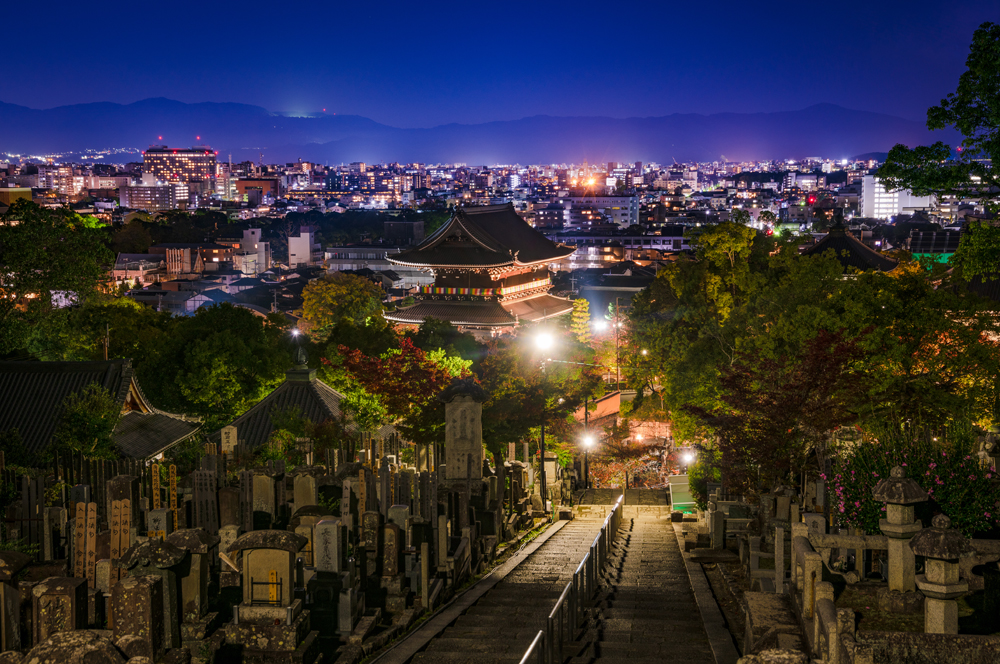
Kyoto becomes an entirely different world after sunset. During the day, it is a historic city filled with temples, tourists, and constant motion. At night, it transforms into one of the most magical places to visit at night, where silence, lantern light, and centuries-old architecture create an atmosphere that feels suspended in time. Darkness removes modern distractions and reveals Kyoto’s true character—quiet, deliberate, and deeply atmospheric.
Why Kyoto Feels More Magical at Night
Kyoto’s architecture was designed long before electric lighting existed. Its streets, wooden houses, shrines, and narrow alleys were built for softer, localized illumination. At night, lanterns and warm artificial lights highlight textures that are invisible during the day. Wooden walls glow softly. Stone paths reflect faint light. Shadows form naturally around structures, enhancing their depth and detail.
This lighting creates visual isolation. Instead of seeing everything at once, you see specific elements. Your brain focuses more intensely on individual details, such as the curve of a temple roof or the pattern of a stone walkway. Darkness removes visual noise, allowing Kyoto’s historical identity to dominate the sensory experience.
Night also removes temporal cues. Without sunlight, the brain loses its normal sense of time progression. This creates a psychological effect where the environment feels older and more permanent, as if it exists outside the present moment.
Lanterns and Traditional Illumination
Lantern light plays a central role in Kyoto’s nighttime transformation. Unlike modern white lighting, traditional lanterns emit warm, low-intensity light. This warmth enhances the natural colors of wood, paper, and stone. Warm lighting also triggers psychological associations with safety and calm, which increases emotional comfort.
Lanterns create gradual transitions between light and shadow rather than harsh illumination. This gradient enhances visual depth and spatial awareness. Streets feel longer. Structures feel larger. The environment appears layered and immersive.
In districts like Gion, lanterns line narrow streets and building entrances. Their consistent spacing creates rhythm and visual continuity. Reflections on slightly wet stone surfaces amplify their brightness, doubling the visual impact.
Reduced Crowds and Emotional Immersion
Daytime Kyoto is crowded. Movement, conversation, and activity dominate sensory input. At night, human activity decreases dramatically. Streets become quiet. Foot traffic slows. This reduction in sensory overload allows the brain to process the environment more deeply.
Silence enhances awareness. Footsteps sound clearer. Air feels cooler. Small visual details become more noticeable. This increases emotional immersion. The city feels less like a tourist destination and more like a preserved historical space.
This quietness also increases perceived authenticity. Without crowds, Kyoto feels closer to its original state. The absence of modern noise allows visitors to experience the environment in a way that more closely resembles its historical past.
Best Locations in Kyoto to Experience at Night
The Gion district is one of the most powerful nighttime locations. Its preserved wooden buildings, narrow streets, and traditional lantern lighting create a highly immersive environment. Minimal modern signage preserves visual continuity.
Yasaka Shrine becomes particularly striking at night. Strategic illumination highlights its structure while leaving surrounding areas in shadow. This contrast enhances its scale and visual presence.
The Arashiyama area also offers a unique nighttime experience. When illuminated, the bamboo grove creates vertical patterns of light and shadow. The towering bamboo structures filter light unevenly, creating motion-like visual effects as the wind moves through them.
Temple pathways throughout Kyoto also become more atmospheric at night. Soft lighting, stone surfaces, and quiet surroundings combine to create a calm, introspective environment.
Best Time to Visit
Kyoto is visually powerful year-round at night, but certain seasons enhance the experience. Autumn introduces illuminated foliage, where red and orange leaves reflect artificial lighting. Spring brings nighttime cherry blossom illuminations, where pale petals glow softly against the dark sky.
Even outside seasonal events, Kyoto maintains its atmospheric presence. Clear nights with minimal cloud cover provide the best conditions for visual contrast. Late evening hours offer the quietest environments, maximizing emotional immersion.
Kyoto at night demonstrates how darkness can reveal, rather than conceal, beauty. The city does not rely on brightness. It relies on contrast, silence, and time.
Place #3 — Bioluminescent Beaches, Maldives: The Ocean That Glows
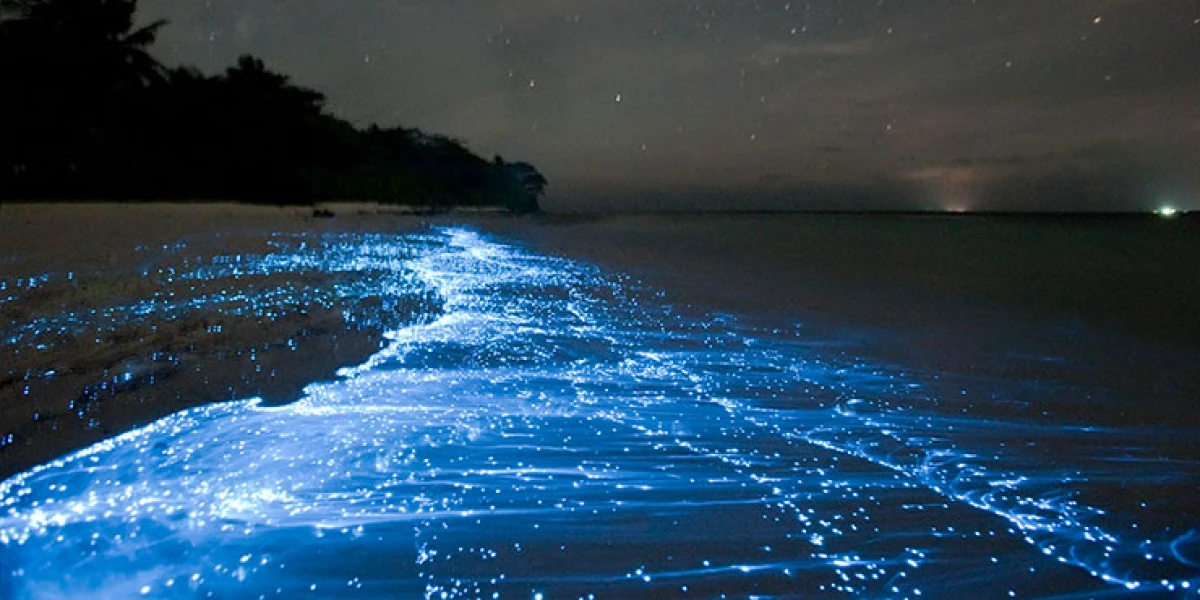
Some of the most magical places to visit at night are not in the sky or on land, but in the ocean itself. In the Maldives, certain beaches glow with a natural blue light, creating an effect often called the “Sea of Stars.” This phenomenon is caused by microscopic organisms known as dinoflagellates, which emit light when disturbed. The result is a shoreline that appears electrically alive, where every wave, step, or movement triggers pulses of glowing blue light.
Why Bioluminescence Is Only Visible at Night
Bioluminescence is extremely faint compared to sunlight. During the day, solar brightness overwhelms the light produced by dinoflagellates, making it invisible. At night, darkness removes this interference, allowing the glow to become visible. The absence of artificial light further enhances the effect, increasing contrast between the glowing water and the dark surroundings.
This contrast makes the ocean appear transformed. Instead of reflecting external light sources, the water becomes its own source of illumination. This reverses normal visual expectations. The brain is not accustomed to seeing water produce light, which creates a strong sense of novelty and wonder.
Darkness also allows human eyes to become more sensitive to low light levels. As night progresses, visual sensitivity increases, making the glow appear brighter and more vivid.
Movement Creates Living Light
The glow intensifies when the water moves. Waves crashing onto the shore trigger bursts of light. Walking along the beach causes glowing footprints. Even small disturbances, such as fish swimming near the surface, create moving streaks of blue illumination.
This motion creates the illusion that the ocean is alive. The light does not remain static. It responds directly to physical interaction. This cause-and-effect relationship strengthens emotional engagement because the environment reacts visibly to movement.
The brain interprets reactive environments as more immersive. When an action produces an immediate visual response, it increases attention and memory retention. Each step becomes part of the experience, rather than passive observation.
Best Locations in the Maldives to See Bioluminescence
Vaadhoo Island is one of the most well-known locations for bioluminescent beaches. Its shoreline frequently displays strong glowing effects due to favorable environmental conditions and plankton concentration.
Other remote islands across the Maldives also experience bioluminescence, particularly in areas with low light pollution and minimal coastal development. Isolation improves visibility by preserving darkness.
Beaches with calm water conditions often provide clearer visibility. Gentle waves create consistent movement, which triggers continuous illumination without disrupting visibility.
Best Time to Visit
Bioluminescence is most visible between late summer and early winter, typically from July through February. Warm water temperatures support higher concentrations of dinoflagellates, increasing glow intensity.
The darkest nights provide the best conditions. Minimal moonlight enhances contrast, making the glow easier to see. Clear skies and low artificial lighting further improve visibility.
Late evening hours often provide optimal viewing conditions. As human activity decreases and environmental light sources diminish, the glow becomes more prominent.
Bioluminescent beaches demonstrate that magic does not require artificial creation. It already exists in nature, waiting for darkness to reveal it.
Place #4 — Paris, France: The City That Becomes Light Itself
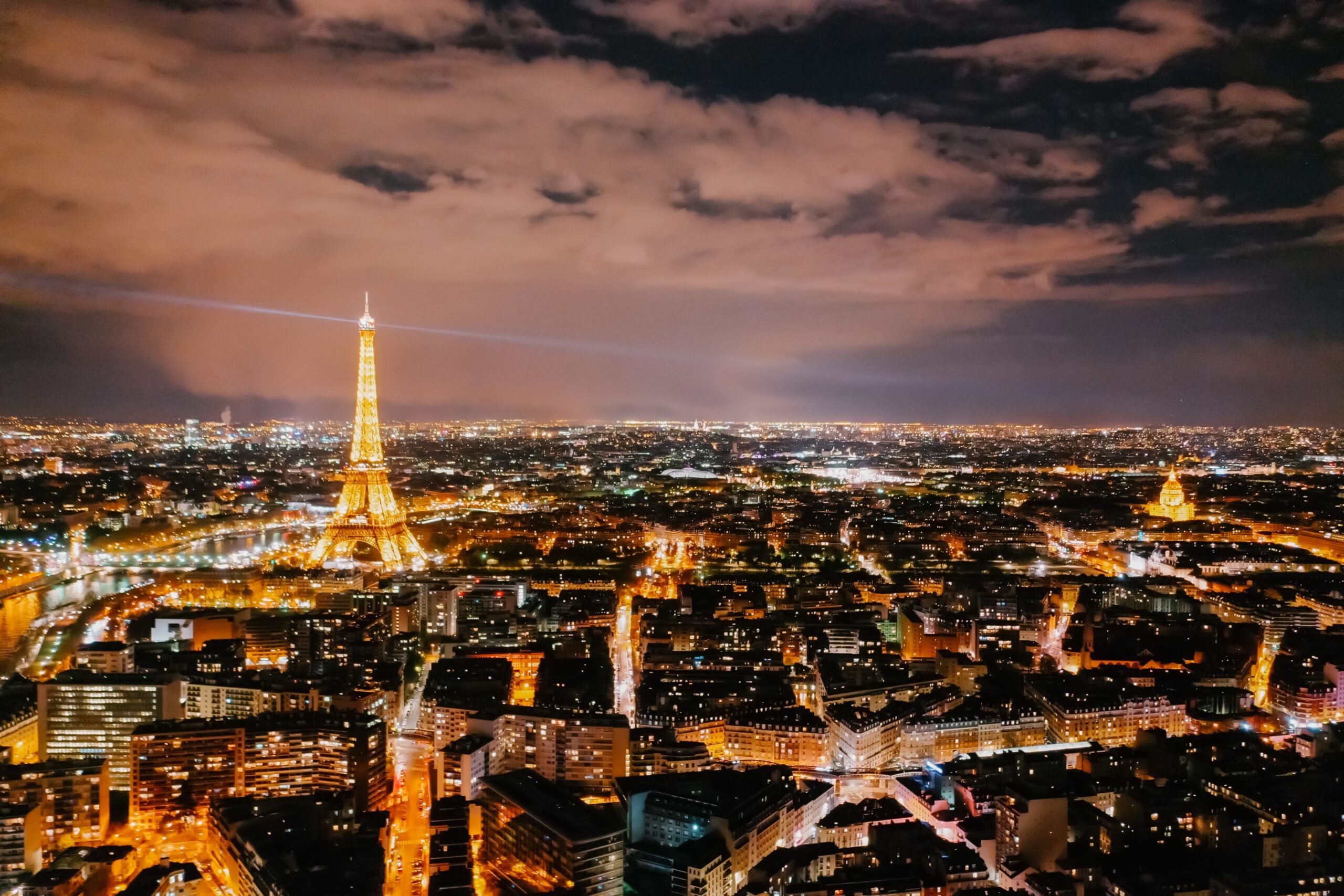
Paris is often called the “City of Light,” but its true identity emerges only after sunset. During the day, Paris is elegant and historic. At night, it becomes one of the most magical places to visit at night, where architecture, reflections, and carefully designed illumination transform the entire city into a living visual experience. Darkness does not hide Paris. It reveals its structure, symmetry, and emotional depth.
Why Paris Feels Completely Different at Night
Paris was one of the first cities in the world to adopt widespread urban lighting. This tradition evolved into an intentional design philosophy. Light is used not just for visibility, but for artistic enhancement. Buildings, bridges, and monuments are illuminated from specific angles to highlight their form and detail.
Darkness removes visual distractions such as traffic density, signage clutter, and daytime haze. Without these competing elements, the brain focuses on structure and light contrast. This increases perceived beauty and scale. The city appears more organized, more dramatic, and more visually intentional.
The absence of sunlight also enhances color perception in artificial lighting. Warm tones dominate Paris at night, creating a golden glow across streets and buildings. This warmth triggers psychological associations with comfort, safety, and emotional calm.
Reflections Multiply the Visual Impact
The Seine River plays a crucial role in Paris’s nighttime transformation. Water reflects light with near-perfect symmetry. Bridges, street lamps, and illuminated buildings appear duplicated on the river’s surface. This reflection increases visual complexity without adding physical structures.
Reflections create motion as well. Water movement distorts light patterns, producing constantly shifting visual textures. The brain interprets this movement as dynamic and engaging, which strengthens attention and emotional response.
Rain amplifies this effect further. Wet streets reflect surrounding lights, creating additional layers of illumination. Pavement becomes a reflective surface, extending the reach of artificial light across the environment.
The Eiffel Tower and Monument Illumination
The Eiffel Tower becomes a focal point of nighttime Paris. Strategic lighting emphasizes its geometric structure, making it visible from long distances. Periodic sparkling light displays introduce motion, which enhances its visual dominance.
Other landmarks, including the Louvre Pyramid and Notre-Dame Cathedral, are illuminated to highlight architectural details. Focused lighting creates contrast between structural elements and surrounding darkness. This isolation makes each landmark appear more prominent and visually significant.
Lighting transforms these structures into visual anchors. They provide reference points that organize spatial perception and guide movement through the city.
Reduced Crowds and Increased Emotional Connection
While Paris remains active at night, sensory intensity decreases compared to daytime conditions. Reduced traffic noise and slower movement allow deeper environmental awareness. The brain processes visual details more thoroughly when distractions are minimized.
This quieter atmosphere enhances emotional engagement. Streets feel more intimate. Architecture feels more personal. The environment encourages slower movement and prolonged observation.
Night also alters time perception. Without daylight cues, the brain becomes less focused on schedules and more focused on the present moment. This increases immersion and strengthens memory formation.
Best Locations in Paris to Experience at Night
The Eiffel Tower and surrounding Champ de Mars area provide wide viewing angles and open space. This allows the tower’s full illumination to dominate the visual field.
The Seine Riverbanks offer continuous visual stimulation. Bridges, reflections, and illuminated buildings create layered visual depth across long distances.
The Louvre Pyramid provides a contrast between modern glass architecture and historic surroundings. Its geometric structure interacts strongly with artificial light, creating sharp visual contrast.
Montmartre offers elevated views of the city. Height increases spatial awareness, allowing observers to see how illumination spreads across the urban landscape.
Best Time to Visit
Paris remains visually powerful throughout the year, but clear nights provide the strongest contrast. Winter offers longer periods of darkness, increasing viewing opportunities. Summer provides warmer temperatures and extended evening visibility.
Late evening hours often provide the ideal balance between illumination and reduced crowd density. Artificial lighting remains fully active while sensory distractions decrease.
Paris at night demonstrates how human-designed light can reshape an entire city. It becomes not just a place, but an experience constructed from illumination, contrast, and perception.
Place #5 — Salar de Uyuni, Bolivia: The World’s Largest Natural Mirror
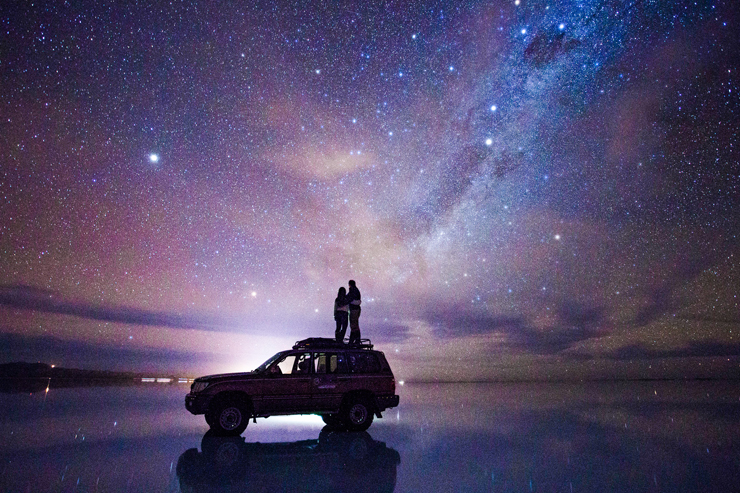
Salar de Uyuni is one of the most surreal and magical places to visit at night because it dissolves the boundary between Earth and sky. Located in southwest Bolivia, this vast salt flat spans over 10,000 square kilometers. During certain conditions, especially after rainfall, its surface becomes perfectly reflective. At night, this reflection turns the ground into a mirror, duplicating the stars above and creating the illusion of standing inside the universe itself.
Why Salar de Uyuni Becomes Magical Only at Night
During the day, Salar de Uyuni appears as an endless white landscape. Its scale is impressive, but its true transformation happens after sunset. Darkness removes visual reference points such as shadows and horizon lines. When the sky fills with stars, the reflective surface of the salt flat mirrors them with remarkable clarity.
This reflection confuses the brain’s spatial perception. Normally, the brain relies on the horizon to distinguish ground from sky. At Salar de Uyuni at night, this distinction disappears. Stars appear both above and below you. The result is a visual environment where up and down lose meaning.
The absence of artificial light is critical. Salar de Uyuni is located far from major cities, which eliminates light pollution. This allows faint celestial objects, including the Milky Way, to become visible. Darkness increases contrast, making stars appear brighter and more numerous.
also read: 5 Best Countries for an International Trip
Reflection Creates Infinite Depth
The thin layer of water that forms on the salt flat after rain creates near-perfect reflectivity. Unlike rough surfaces, the flatness of Salar de Uyuni minimizes distortion. This produces sharp, symmetrical reflections of stars, planets, and the Milky Way.
This symmetry creates a powerful illusion of infinite depth. The brain interprets mirrored stars as extending beyond physical space. This visual effect triggers awe because it expands perceived environmental scale far beyond normal human experience.
Even small light sources, such as distant vehicles or moonlight, create dramatic reflections. These isolated light points appear suspended in space, enhancing the sense of immersion.
Best Locations Within Salar de Uyuni
The central regions of the salt flat provide the strongest mirror effect because they are farthest from land boundaries. Isolation eliminates visual interruptions, preserving the illusion of infinite reflection.
Areas with shallow standing water provide optimal reflectivity. Even a thin layer can produce strong mirror effects when the surface remains undisturbed.
Isla Incahuasi, a cactus-covered island within the salt flat, provides elevated viewing positions. From higher ground, observers can see how reflections extend across the landscape.
Best Time to Visit
The best time to experience the mirror effect is during the rainy season, typically between December and April. Rain creates the thin water layer necessary for reflection. However, clear skies are equally important. Cloud cover blocks star visibility and reduces the effect.
Moonless nights provide the strongest star visibility. Without moonlight, faint celestial objects become visible, increasing visual density.
Late night and early morning hours offer optimal conditions. During these periods, the sky reaches maximum darkness, and atmospheric stability improves visibility.
Why the Experience Feels Unreal
Salar de Uyuni disrupts the brain’s normal visual expectations. Humans evolved to interpret solid ground and distant sky as separate entities. At Uyuni, this separation disappears. The environment becomes visually ambiguous.
This ambiguity increases attention and emotional impact. The brain struggles to categorize what it sees, which enhances memory formation. Experiences that violate normal perception are remembered more vividly.
Salar de Uyuni at night does not simply reflect the sky. It removes the boundary between observer and universe, creating one of the most immersive visual experiences possible on Earth.
Here is a comparison table you can use in your blog to clearly differentiate the most magical places to visit at night based on visual experience, uniqueness, and best conditions:
| Place | Country | Type of Night Magic | Main Visual Feature | Best Time to Visit | Why It Feels Magical |
| Northern Lights, Iceland | Iceland | Natural sky phenomenon | Moving aurora lights in the sky | September to March | The sky becomes dynamic and alive with constantly shifting colors and patterns |
| Kyoto | Japan | Cultural and architectural illumination | Lantern-lit streets and temples | Year-round, best in spring and autumn | Traditional lighting, silence, and preserved architecture create a timeless atmosphere |
| Bioluminescent Beaches, Maldives | Maldives | Natural ocean bioluminescence | Glowing blue waves and shoreline | July to February | The ocean produces its own light, reacting to movement and creating interactive visuals |
| Paris | France | Urban architectural lighting | Illuminated landmarks and river reflections | Year-round, best on clear nights | Strategic lighting and reflections transform the city into a visually immersive environment |
| Salar de Uyuni | Bolivia | Natural reflection phenomenon | Mirror-like ground reflecting stars | December to April (rainy season) | The ground reflects the sky, removing the boundary between Earth and space |
This comparison highlights an important pattern. The most powerful nighttime destinations fall into three categories: cosmic phenomena (Iceland, Uyuni), biological light (Maldives), and human-designed illumination (Kyoto, Paris). Each activates different perceptual mechanisms in the brain, but all rely on darkness to amplify contrast, depth, and emotional impact.
Conclusion: Why Night Reveals the World’s Most Magical Experiences
Darkness does not remove beauty. It reveals it in its purest and most emotionally powerful form. The most magical places to visit at night are not defined only by their physical structure, but by how light and darkness interact to reshape perception. When sunlight disappears, selective illumination, natural phenomena, and reduced sensory noise allow the brain to focus more intensely on what remains.
Places like Iceland’s Northern Lights and Bolivia’s Salar de Uyuni demonstrate how nature uses darkness to create cosmic-scale visual experiences. The Maldives shows how living organisms can turn the ocean into a light source. Cities like Kyoto and Paris prove that human-designed lighting can enhance architecture, emotion, and atmosphere. In each case, darkness increases contrast, depth, and emotional resonance.
There is also a neurological dimension. The human brain evolved to be highly sensitive to contrast and motion in low-light environments. At night, fewer visual distractions allow deeper processing. This strengthens emotional connection and memory formation. Experiences feel more personal, immersive, and meaningful because attention is no longer divided.
Night also changes psychological perception. Quiet environments reduce cognitive overload. Slower movement, softer lighting, and visual isolation create a sense of calm and presence. This allows people to engage with environments more consciously, rather than passively observing them.
These destinations remind us that the world has two identities. One exists in daylight, defined by clarity and function. The other exists in darkness, defined by contrast, mystery, and emotional depth. The most powerful travel experiences often happen not when everything is visible, but when light and shadow work together to transform reality.
